Step 01
Start local services
docker compose up -dAWS Data Engineering
End-to-end flight fare pipeline with a fast local demo path and a documented production-style AWS architecture, orchestrated with Airflow and modeled with dbt.

Local demo
Docker + Postgres
AWS path
S3 + Redshift runbook
Orchestration
Airflow DAG + logs
Modeling
dbt marts + tests
Reviewer proof
Screenshots, SQL, CI
Fast local validation path
The fastest review path is local: start Postgres, load the sample fares, build the marts with dbt, then run the proof queries that show downstream readiness.
Step 01
Start local services
docker compose up -dStep 02
Load sample fares
python scripts/load_sample_to_postgres.pyStep 03
Build dbt models
dbt build --project-dir dbt/flight_fares --profiles-dir dbt
Step 04
Run proof queries
python scripts/run_analysis_queries.pyArchitecture
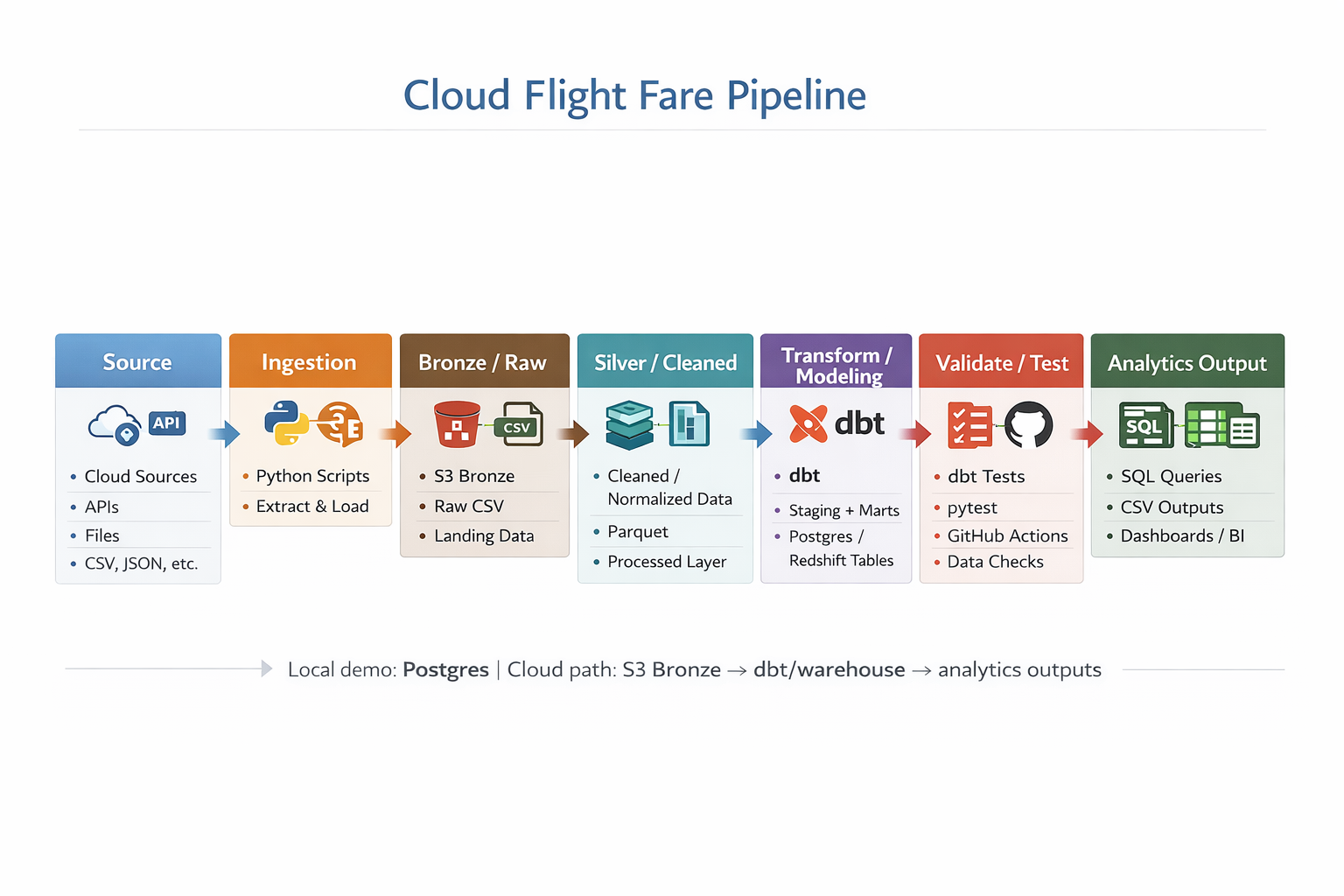
The repo is strongest when reviewed as a proven local demo path plus a documented production-style AWS target. Both routes converge on dbt-modeled marts and SQL outputs that are ready for analytics review.
marts.fact_fares, marts.dim_route, and marts.dim_date.Architecture Diagram
Repo architecture overview showing ingestion, bronze/raw landing, silver/cleaned processing, dbt modeling, validation, and analytics outputs.
Analytics-ready outputs
This case study does not stop at ingestion and modeling. The repo documents the marts, the analyst query patterns, and the downstream output handoff so reviewers can see what gets delivered after the pipeline runs.
marts.fact_fares and marts.dim_route support pricing trends by route.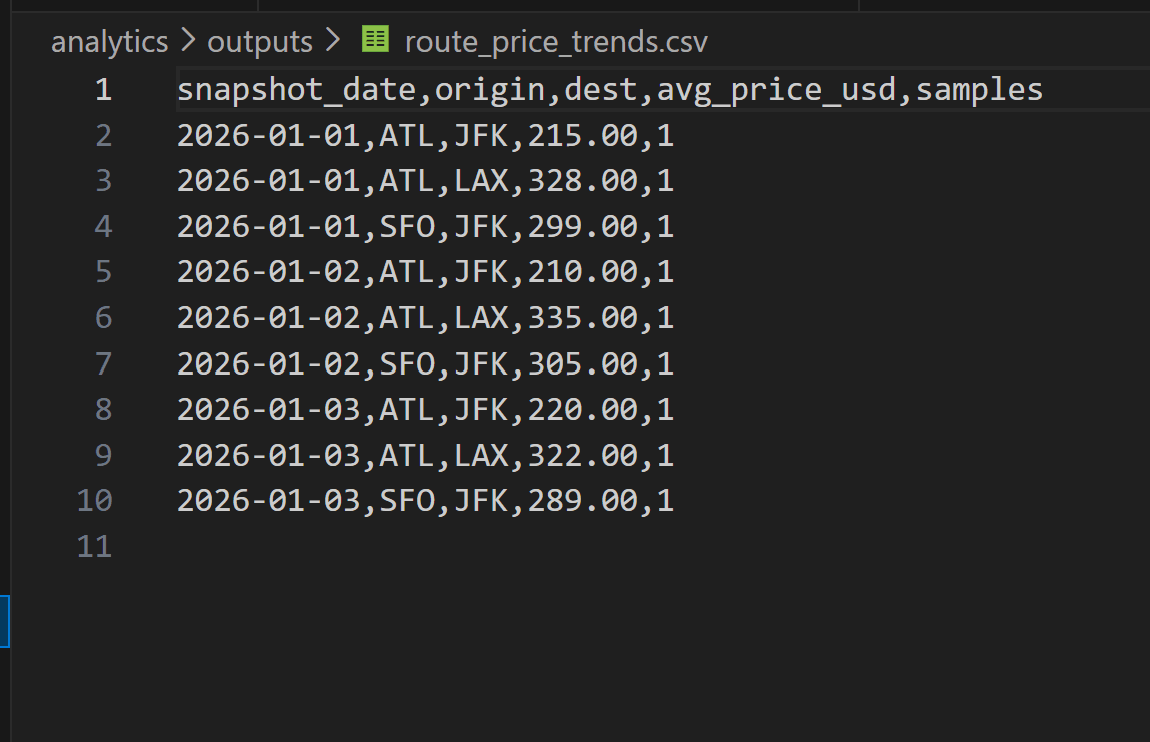
The repo includes a static downstream artifact for reviewer handoff. It is shown here as documentation evidence, not as a claim of a live hosted BI application.
Execution Proof
Reviewer evidence is surfaced here instead of being hidden behind link lists. The screenshots below come from the project repo and cover storage proof, orchestration proof, execution logs, and downstream artifact handoff.

Week 3 proof showing dated fare snapshots stored under the bronze bucket path.

Week 5 Airflow graph view showing the local load, dbt build, and proof-query chain.

Saved Airflow task-log evidence for a successful dbt build and model tests.

Static repo artifact for downstream analytics handoff. It is not presented here as a live hosted BI app.
Start with the local demo path, then review the AWS/Redshift runbook, followed by the proof assets and docs for the documented target. That keeps the proven local scope and cloud target easy to separate.